
India is emerging as one of the top data center markets in the world due to a massive internet user base, strong government initiatives and data localization policies. Global tech giants are investing billions of dollars to build cloud regions, while the country's booming AI, BFSI, and startup ecosystems continue to push compute demand to new heights. As businesses seek locations that can offer scale, resilience, cost efficiency, and green operations, Chennai is emerging as a significant contender in the Asia-Pacific region.
Chennai's status as the world's third most affordable location for data center construction makes it highly attractive, and the city now anchors five active submarine cable systems, drawing hyperscalers, CDN providers, and gaming servers that require sub-25 ms round-trip times.
Chennai’s data center market is expected to reach 134 MW by 2026. According to Mordor Intelligence, the Chennai data center market is expected to reach 551.15MW by 2030.
Chennai holds the second-largest data center capacity in India, following Mumbai. In 2026, Chennai is seeing a new wave of large‑scale commitments, with disclosed plans from leading operators and investors representing well over ₹18,000 crore (around USD 2–2.5 billion) in data center investments concentrated in and around the city.
This article provides a detailed comparative analysis of Chennai against established data center hubs such as Singapore, Johor Bahru, Seoul, and Tokyo, updated with 2026 market realities and insights tailored for senior IT leaders.
In terms of infrastructure
Recently, the Tamil Nadu Electricity Regulatory Commission (TNERC) cleared the procurement of 270 MW of firm and dispatchable renewable energy (FDRE) by the Tamil Nadu Power Distribution Corporation (TNPDC) from the Solar Energy Corporation of India (SECI). With this move, the state strengthens its renewable basket while securing dependable, round-the-clock clean power.
In its reasoning, the Commission draws from projections in the National Electricity Plan, which estimates India’s renewable capacity will touch 596 GW by 2032, including 365 GW of solar and 122 GW of wind. Against this backdrop, Tamil Nadu positions itself for a sharper transition, with the share of renewables in its energy mix expected to climb from 30% to 50% by 2030. (Source: The Hindu)
TNERC approves the 270 MW FDRE procurement for a 25-year period, giving long-term certainty to the distribution utility and aligning procurement strategy with the state’s clean energy trajectory.
The regulator also notifies the Tamil Nadu Electricity Grid Code, 2026, as it prepares the grid for deeper renewable integration. The updated code focuses on managing higher renewable penetration and maintaining system stability as the energy mix evolves.
The region supports modern multi-story data center facilities and is favored by hyperscale cloud providers investing in greenfield projects. Strategic policy measures, like the Tamil Nadu Data Centre Policy 2021, offering 100% electricity tax exemption for five years, amplify its appeal.
Singapore, in comparison, has a highly advanced and dense data center infrastructure with significant subsea cable hubs. However, limited land availability inhibits large-scale expansion, forcing operators to innovate within constrained physical footprints while maintaining green building standards.
Johor Bahru is ramping up infrastructure rapidly, benefiting from proximity to Singapore, but its infrastructure maturity and power reliability are still catching up. Seoul features advanced infrastructure with strong power availability, but has limited scalable land plots, affecting construction timelines. Tokyo maintains a reliable power grid with ongoing investments but faces power supply challenges and high construction costs.
Connectivity
Connectivity is critical for latency-sensitive workloads, and Chennai enjoys a strategic advantage with six submarine cable landing stations (including SEA-ME-WE 4, BBG, and I-ME-WE) directly connecting the city to Southeast Asia, Europe, and the Middle East. This connectivity ecosystem supports the city’s low-latency promise for hyperscalers and enterprise clients.
Singapore remains the regional leader in international bandwidth with one of the world’s most dense and diverse submarine cable networks, but expansion potential is limited by land constraints. Johor Bahru is growing as a spillover hub benefiting from Singapore’s infrastructure, but it has yet to achieve parity in network redundancy.
Seoul offers strong domestic and international connectivity supporting advanced network needs, while Tokyo maintains reliable fiber infrastructure, though power and cost bottlenecks encourage businesses to look at alternative sites.
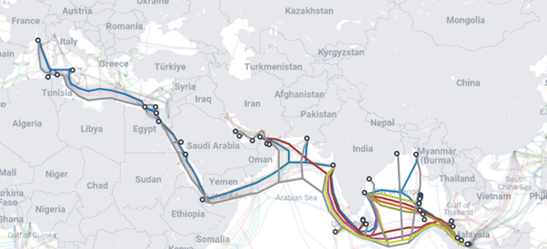
Source: Submarine Cable Map
Geographical stability
Chennai sits in Seismic Zone III, indicating moderate earthquake risk but benefits from well-established cyclone preparedness governance and resilient infrastructure design. This moderate risk profile contrasts favorably with Tokyo, located in the highly active Pacific Ring of Fire and recently reminded of seismic vulnerabilities post-Fukushima.
Singapore enjoys very low seismic risk and is stable politically, though land scarcity limits large-scale expansions. Johor Bahru faces generally low seismic threats but varies by site in flood risks and infrastructure resilience. Seoul experiences low seismic risk but suffers logistical challenges owing to urban density.
Policies driving growth and business environments
The Tamil Nadu Data Centre Policy 2021 exemplifies Chennai’s proactive business climate, with incentives like electricity tax exemptions, stamp duty waivers, relaxed multi-story construction norms, and workforce training subsidies. This supportive environment enables faster approvals and lowers entry costs for investors.
Singapore offers a stable regulatory framework, strong data flow protection laws, and targeted tax incentives. It allows 100% foreign ownership, but land scarcity and high operating costs challenge new entrants. Johor Bahru benefits from SEZ status and close integration with Singapore’s ecosystem, though it remains in a developmental phase. Seoul and Tokyo provide robust regulatory frameworks but suffer from higher costs and urban constraints.
Cost advantage
According to JLL’s 2025 Global Data Center Outlook, Johor Bahru (Malaysia) and Dallas-Fort Worth (United States) are ranked as the top two most cost-effective cities globally for building data centers, followed closely by Chennai (India) in third place. This ranking reflects these cities’ advantages in lower land acquisition, construction, and operational costs compared to other international hubs.
As per estimates, the land and real estate costs are lower than in Singapore, Seoul, and Tokyo, alongside comparatively cheaper operational expenses such as power and skilled workforce availability. These factors combine to deliver superior ROI for large-scale hyperscale deployments.
Singapore is among the world’s most expensive data center markets due to high land prices, pay scales, power tariffs, and carbon taxes. Johor Bahru offers lower land costs than Singapore, but it still needs to improve infrastructure reliability. Seoul’s costs are higher due to urban density, while Tokyo exhibits some of the highest real estate and power expenses in the region.
Market growth
The Chennai data center market is set to grow from around 202 MW in 2025 to 551 MW by 2030, reflecting a CAGR of approximately 22%, driven by BFSI, cloud providers, IT services, and e-commerce. Strategic hubs like Ambattur and Siruseri anchor this growth, attracting hyperscalers and enterprises alike.
Singapore’s data center market is mature and highly developed, with over 70 operational data centers. The market is projected to grow steadily with new capacity additions of approximately 300 MW planned by 2030, driven by strong demand from hyperscalers and enterprise users embracing AI and cloud technologies. Despite this growth, land scarcity and high real estate prices within city limits severely limit large-scale expansion. Consequently, expansion efforts are encouraging spillover growth in adjacent regions such as Johor Bahru in Malaysia and Batam in Indonesia.
Johor Bahru is rapidly emerging as a key spillover data center market, supported by more affordable land and power costs relative to Singapore. However, concerns remain over long-term resource sustainability, particularly water and electricity availability, which could impact future growth trajectories.
Seoul’s data center market is stable, supported by steady demand from local enterprises and hyperscalers. Despite advanced infrastructure, the limited available land parcels constrain substantial new developments, impacting capacity growth.
Tokyo continues to hold the largest data center market capacity in the Asia-Pacific region. However, ongoing challenges, including limited power availability, high construction costs, and seismic risk management, have made expansion more complex and costly. This has prompted some operators to explore alternate nearby locations for new builds.
Technical advancement
Chennai is emerging as a future-ready hub, with key facilities equipped for AI workloads and edge computing, supporting rack densities above 50 kW and integrating renewable energy, e.g., AdaniConneX Chennai data center. This aligns it with global trends emphasizing green, secure, high-density infrastructure.
Singapore leads the region in AI/ML capabilities and edge data center ecosystems, underpinned by its telecom infrastructure. Johor Bahru is enhancing capabilities alongside organizational maturity. Seoul supports advanced cooling and AI-optimized architectures but faces cost pressures, whereas Tokyo is renowned for technical innovation but challenged by logistical and cost constraints.
Conclusion
Chennai today stands at a defining moment in its evolution as a digital infrastructure hub. While global markets such as Singapore and Tokyo have long been established centers for data infrastructure, Chennai offers a compelling combination of scalable infrastructure, strategic subsea connectivity, cost competitiveness, and supportive policy environment. Backed by strong enterprise demands, hyperscaler investments, and a rapidly expanding digital economy, the city is steadily strengthening its position in the global data center landscape.
As India’s digital transformation accelerated and AI-driven workloads reshape infrastructure demand, Chennai is uniquely positioned to emerge not just as a regional stronghold, but as one of the most significant gateways for the next generation of global data center infrastructure.
While Chennai may not yet match Singapore’s bandwidth density or Tokyo’s technological heritage, it offers a powerful combination of scalable infrastructure, strategic connectivity, cost competitiveness, and resilience shaped by favorable policies and market momentum. Its trajectory from a strong regional player to a global contender is underscored by robust investments, hyperscaler footholds, and a forward-looking ecosystem embracing AI and sustainability agendas.
For players evaluating Asia-Pacific data center options, Chennai represents a compelling choice balancing performance, cost, and growth potential.