
What makes Chennai, India’s next hyperscale and sustainable data center capital
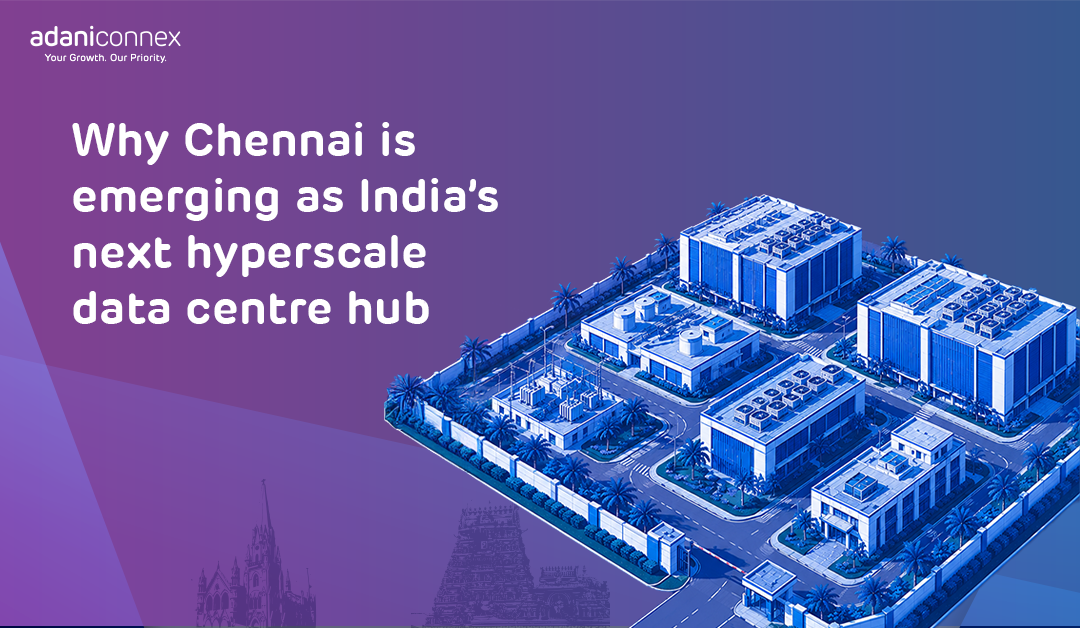
Chennai is rewriting India's data center map. The city has moved decisively past its reputation as a secondary market and is now competing head-to-head with Mumbai and Bangalore and winning on several fronts. Reliable power infrastructure, deep subsea cable connectivity, lower land and operational costs, and a proactive state government have combined to make Chennai the most compelling new destination for hyperscale and sustainable data center investment in the country.
The numbers tell a confident story. The Chennai data center market stood at approximately 202 MW in 2025 and is on track to reach 551 MW by 2030, growing at a CAGR of 22 percent. Ongoing projects will add 134 MW of capacity by 2026 alone, with another 130 MW in the pipeline for 2027–2028. Investment commitments are accelerating in step, disclosed plans from leading operators now represent well over ₹18,000 crore (approximately USD 2 to 2.5 billion) concentrated in and around the city.
Chennai has also climbed the rankings. The city now holds the second-highest data center capacity in India, contributing around 21 percent of the country's total installed base, a meaningful leap from its earlier third-place position. Hyperscale cloud providers and enterprise operators are driving this surge, drawn by occupancy levels that signal a market firing on all cylinders.
Reliable and green power infrastructure enables scalability
Tamil Nadu does not just support Chennai's data center ambitions; it actively powers them. The state has built one of India's most advanced and diversified clean energy platforms, giving operators something increasingly rare in a power-constrained world: reliable, scalable, and genuinely green electricity.
Tamil Nadu ranks fourth in renewable energy generation in January, producing 3,119 million units (MU) of electricity, according to data from the Ministry of New and Renewable Energy. In the solar segment, the state marginally outperforms Karnataka, generating 1,683 MU compared to Karnataka’s 1,678 MU.
The state government is actively layering new capacity across wind, solar, pumped hydro, and small hydropower, underpinned by clear policy commitments and a track record of execution that few Indian states can match.
For data center operators, the policy framework is equally compelling. Tamil Nadu's data center policy requires facilities to meet at least 30 percent of their energy requirements from renewable sources and offers a 100 percent subsidy on electricity tax for five years, alongside significant stamp duty exemptions depending on location. Global hyperscalers are already acting on this.
The engineering inside Chennai's facilities matches the ambition of the grid outside. Liquid cooling is no longer a niche upgrade; it is fast becoming the operational backbone of AI-era data centers, driven by GPU-dense workloads that push power densities well beyond what traditional air cooling can manage. Liquid systems can deliver significant improvement in PUE, often achieving values below 1.2, while closed loop designs simultaneously reduce water consumption by eliminating the evaporation of losses inherent in air-cooled systems. Chennai's leading facilities are deploying direct-to-chip cold plates, rear-door heat exchangers, and immersion cooling systems purpose-built for high-density AI workloads, workloads where today's Nvidia Blackwell chips draw 1,000 to 1,400 watts per chip, pushing rack power requirements to levels that make air cooling operationally and economically indefensible.
Sustainability of accountability has also shifted decisively from corporate reporting into procurement requirements. Enterprise customers and hyperscalers now demand auditable data to support their ESG disclosures, including third-party certified PUE tracking, renewable sourcing backed by long-term capacity commitments, and carbon performance data reportable through recognised frameworks. Chennai operators are building these standards from the ground up, not retrofitting compliance onto legacy infrastructure.
Dependable green power, a state policy framework that rewards clean energy investment, and next-generation cooling engineering together form the foundation of Chennai's scalable, sustainable data center ecosystem. But power is only one side of the equation, global connectivity is the other.
Submarine connectivity and strategic location
Chennai’s eastern coastal location has long made it a strategic point for international data exchange. The city accommodates a dense cluster of subsea fiber-optic cables, including major systems like SEA-ME-WE 5, SEA-ME-WE 6, MIST, Bay of Bengal Gateway, and the recently launched India-Asia-Express and India-Europe-Express cables. These systems enhance Chennai’s bandwidth capacity and international connectivity, offering ultra-low latency and high resilience. The presence of these cables ensures uninterrupted, high-capacity data transfer between India and key global markets such as Southeast Asia, Europe, and the United States, thereby supporting the rapid growth of hyperscale and enterprise data centers in the region.
Recent infrastructure investments have further strengthened Chennai’s position as a submarine cable hub. Leading telecom operators have integrated the latest cable systems directly with major data center campuses, boosting service delivery and scalability. Furthermore, emerging subsea cable projects expected to go live in coming time, including the India-Asia-Express and India-Europe-Express, will multiply India’s internet capacity. This diverse submarine cable ecosystem not only ensures redundancy and network resilience but also strengthens Chennai’s role as a key digital gateway, empowering data centers with reliable, scalable, and world-class international connectivity.
From a disaster resilience standpoint, Chennai offers a lower risk profile compared to other metros. Situated in Seismic Zone III, it presents lower earthquake vulnerability versus cities like Delhi or Mumbai. While the city is exposed to occasional cyclones, comprehensive mitigation plans, including the Tamil Nadu State Disaster Management Plan 2023, offer reassurance for business continuity.
This resilience, combined with its coastal advantage, makes Chennai a safe and strategic choice for operators seeking long-term stability.
Moreover, Chennai’s eastern location enables it to serve as a natural gateway to Southeast Asia, with proximity to hubs like Singapore, facilitating lower-latency data exchange and regional redundancy.
Competitive cost structure and skilled workforce
Chennai strikes a rare balance between quality infrastructure and cost advantage. Land costs for data center development are lower than in Mumbai or NCR. Availability of SEZs and IT parks further enhances value by offering tax breaks and regulatory simplifications. On the operational side, industrial tariff electricity rates, coupled with state subsidies, reduce energy expenditure, are a major cost center for data centers.
These structural advantages directly improve TCO (Total Cost of Ownership) for large-scale deployments.
Chennai has a fast-growing talent pool driving its expanding data center industry in 2026. The workforce is set to grow 1.4 times by 2030, reaching over 320,000 professionals, supported by engineering institutions, industry-academia collaboration, and government skilling programs. With strong expertise in AI, robotics, and data science, the city offers a steady pipeline of skilled talent, making it a prime destination for technology-led enterprises and hyperscale data centers.
Chennai reports strong confidence in the local talent pool, especially for supporting advanced workloads including AI and cloud services, underpinned by ongoing investments in workforce upskilling and specialized training.
Government policy driving ecosystem maturity
The Tamil Nadu Data Center Policy is a key enabler behind Chennai’s sustained momentum. The policy provides:
- 100% electricity tax exemption for five years
- Stamp duty concessions on land and buildings
- Relaxed building norms for vertical stacking
- Training subsidies to support local talent development
It defines data center units with a minimum investment of ₹500 crore in Eligible Fixed Assets and excludes captive centers from incentives. The policy offers a 100% electricity tax waiver for five years, concessional open access charges, and dual power supply from two different grids for facilities with a sanctioned load of 50 MW or more. It also provides a single-window clearance through the Guidance portal.
These policy levers reduce operational friction and give global operators confidence in long-term scalability.
This is complemented by infrastructure investments in power distribution, fiber backbone expansion, and green energy generation, all part of Tamil Nadu’s long-term digital infrastructure roadmap.
Overall, Chennai offers not just capacity but a future-ready ecosystem, where sustainable power, global connectivity, cost efficiency, and skilled talent converge to de-risk operations and accelerate digital growth.
.png?width=352&name=image%20(4).png)
.png?width=352&name=Image%20(4).png)